Matches rarely unfold as a smooth, uninterrupted run of actions. You walk a stage, you visualize a sequence, and then something happens: a delay because of logistics, a conversation, a wind call, or simply the time it takes to move and get set. Those interruptions are tiny, real-world stressors — and they’re exactly what our new Real Mode recreates.
Introducing a break – A small but useful step
Real Mode inserts short, forced pauses into the sequence so you can’t click straight away. That small design change does two things at once: it increases the working memory demand (you must hold the whole sequence) and it simulates the interruption/return dynamic that often breaks plans on match day. The net effect is more realistic cognitive training than immediate recall alone.
The science behind memory training
Why does this help in practice? First, stress reliably reduces the capacity of working memory — the mental workspace you use to hold and manipulate a short sequence of information — so skills that rely on it are vulnerable under pressure. Meta-analytic and experimental work shows acute stress impairs executive functions and working memory, especially when tasks require manipulation rather than simple maintenance.
Second, pressure-related performance failures — what researchers call “choking” — are often tied to working memory overload. Experts have shown that even very skilled performers can fail when their working memory is consumed by the stress of the situation, not by lack of practice. Training the specific cognitive load you face in a match reduces that vulnerability.
Third, having to retrieve the whole plan after a pause is a form of retrieval practice — one of the most robust ways we know to strengthen memory. Repeatedly recalling a sequence under slightly harder conditions (delays, interruptions) makes that memory more durable and easier to access when it counts. That “testing effect” reliably improves long-term retention compared with passive study.
Finally, deliberately introducing small, controlled difficulties — like pauses — creates what memory researchers call “desirable difficulties.” These added challenges slow initial performance slightly but make the skill more resistant to failure under different contexts, including stress. In short: a harder practice that mirrors match demands creates more flexible memory.
Real mode in practice
Real Mode also mirrors the cognitive effect of real interruptions. Research on interruptions and prospective memory shows that being forced to resume a task after a break requires different planning and reminder strategies — exactly the skill Real Mode trains. That transfer makes the mode more than just a harder game; it’s rehearsal for the messy realities of competition.
If you want mental preparation that behaves more like match day, give Real Mode a few sessions. Expect it to feel harder at first — then notice how much more reliable your recall becomes when the pressure is on.
Try Real Mode at prsle.com and see the difference in your next Daily Challenge.
Instructions for Real mode
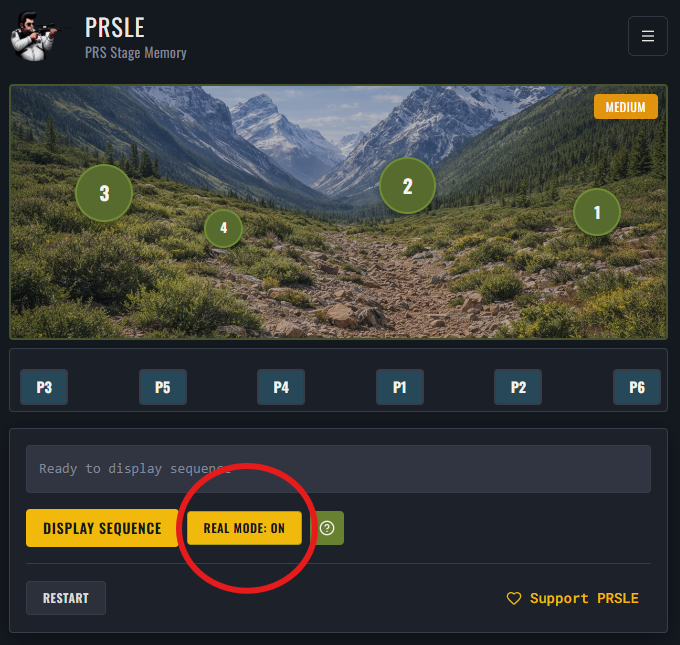
1. To activate Real Mode select the Real Mode button in Training mode (green button next to the Display Sequence button)
2. Once you press Display Sequence the sequence is shown as usual. The difference now is that when you press the Start button you can press the position button (P1) but the target buttons are locked. It is first when the timer in the top left corner reaches zero that you can click the target.
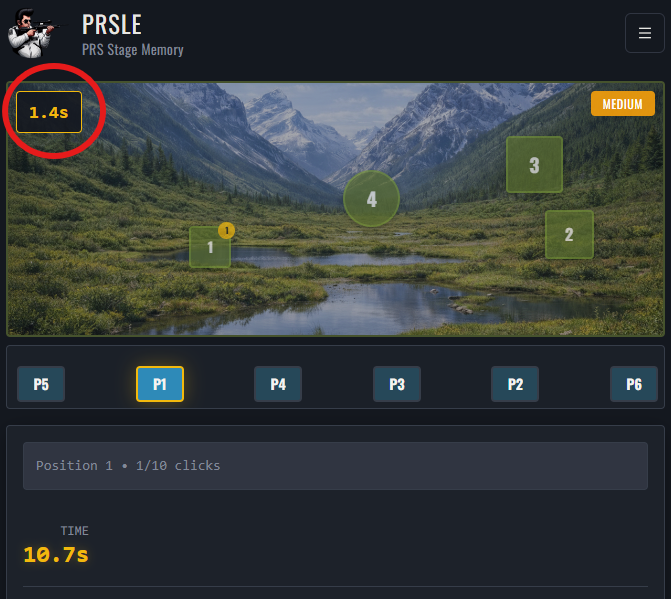
3. If you selection was a hit you will get a notification, if it was a miss you don’t get one, just like in a match. When you have clicked the target the countdown start once again and the target buttons are locked.
4. The total time is counted as the time you take to memorize the sequence plus the time you use between the timer countdowns.
Referenceshttps://www.sciencedirect.com/science/article/abs/pii/S0149763416302755
https://pubmed.ncbi.nlm.nih.gov/17484426/
https://psychnet.wustl.edu/memory/wp-content/uploads/2018/04/Roediger-Karpicke-2006_PPS.pdf
https://bjorklab.psych.ucla.edu/wp-content/uploads/sites/13/2016/04/EBjork_RBjork_2011.pdf
https://www.researchgate.net/publication/227643114_Interruptions_Create_Prospective_Memory_Tasks
Upptäck mer från
Prenumerera för att få de senaste inläggen skickade till din e-post.